Artificial intelligence agents are no longer tools that respond to human prompts. They are becoming autonomous economic actors: entities that can hold digital wallets, initiate payments, negotiate with other agents, and execute complex financial workflows without direct human intervention. This report examines the emergence of Agentic Finance, the infrastructure that enables it, the data that measure its early traction, and the regulatory questions that remain unresolved.
The thesis is straightforward. Blockchain, particularly stablecoin rails, provides the permissionless financial layer that AI agents require to transact freely across borders and systems. Early data from on-chain analytics confirm the transition from experiment to deployment: more than 400,000 AI agents now hold active wallets, and cumulative agent transactions exceeded 150 million within twelve months of the first live protocols.
For institutional participants and regulated digital asset firms operating under frameworks such as MiCA, this shift has material implications. The compliance architecture designed for human account holders does not straightforwardly apply to autonomous software agents acting as financial counterparties. Resolving that gap is among the most consequential regulatory questions of the next two years.
1. What is Agentic Finance?
The term captures a structural shift in how financial tasks are initiated and executed. In conventional digital finance, software automates well-defined, pre-scripted operations: a rule fires, a transaction executes, a report generates. The human remains the locus of intent and decision. Agentic systems are categorically different. An AI agent perceives its environment, reasons about it, sets sub-goals, and takes sequences of actions to accomplish a broader objective without requiring human approval at each step.
Applied to finance, this means an agent can be instructed to "optimize my treasury yield subject to these constraints" and then autonomously scan protocols across multiple chains, assess smart contract risk, bridge assets, execute deposits, monitor positions, and rebalance in response to changing conditions. The instruction is singular; the resulting workflow is multi-step and continuous.
1.1 Three Eras of Financial Automation
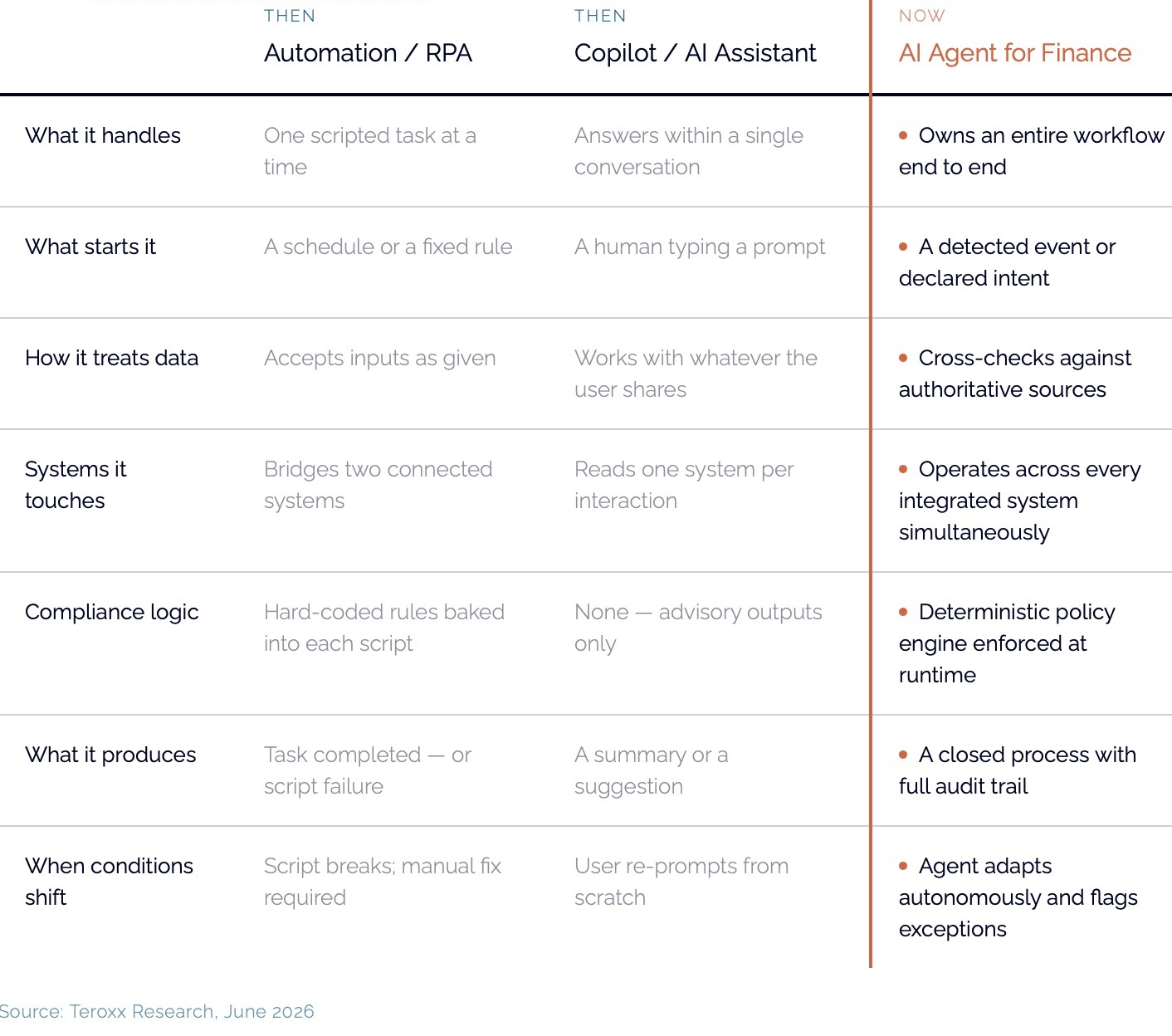
Understanding what makes agentic systems distinct requires placing them alongside the two prior generations of financial automation: Automation/RPA and Copilot/AI Assistant.
The table above captures six dimensions that differentiate the current generation from its predecessors. The most consequential distinction is how each generation handles unexpected inputs. Robotic Process Automation (RPA) breaks when the script encounters an unscripted event. A Copilot defers back to the human. An AI agent for finance adapts, flags the anomaly, and continues. This property, adaptive execution with audit trail, is what makes agents suitable for processes too complex and dynamic for earlier automation generations.
The output distinction matters equally. A copilot produces a suggestion. An agent for finance completes the process with full auditability. The difference between a recommendation and an executed transaction is the difference between an advisory layer and an autonomous counterparty, with significant legal and regulatory implications.
2. The Infrastructure That Makes It Possible
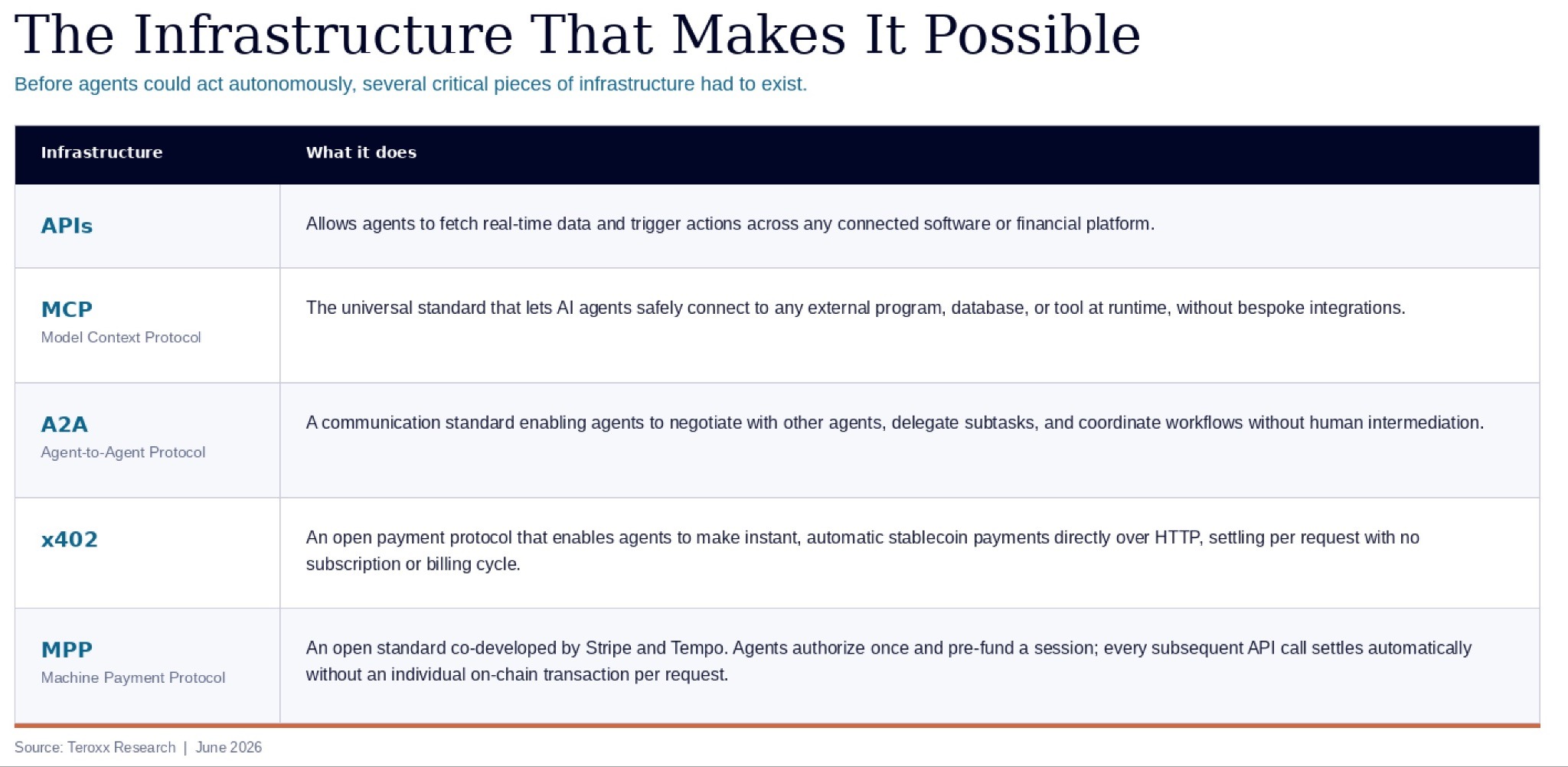
Agentic finance is not a single protocol or platform. It is an emergent capability built on the convergence of four infrastructure layers that had to mature simultaneously before autonomous financial agents could operate at scale.
2.1 APIs
Application Programming Interfaces remain the foundational connective tissue. For AI agents, APIs are the sensory layer: the mechanism by which an agent fetches market data, reads portfolio state, accesses off-chain information, and triggers actions in connected software systems. The proliferation of standardized financial APIs across exchanges, custodians, data providers, and DeFi protocols is what gives agents the informational breadth to reason across markets.
2.2 MCP (Model Context Protocol)
MCP is the universal standard for allowing AI models to safely and dynamically connect to external programs, databases, and tools. Developed by Anthropic and rapidly adopted across the AI infrastructure ecosystem, MCP transforms how agents interact with services. Rather than requiring bespoke integrations for each tool, MCP provides a standardized channel for an agent to discover and use capabilities at runtime. In financial applications, this means an agent can connect to a custodian API, a compliance database, a risk engine, and a settlement system through a common protocol.
2.3 A2A (Agent-to-Agent Protocol)
A2A is a communication standard developed by Google enabling agents to negotiate with other agents, delegate subtasks, share state, and resolve conflicts. In a multi-agent treasury management architecture, a strategic allocation agent might delegate execution to a specialist trading agent and a risk monitoring agent, all coordinating via A2A without human intermediation at each handoff.
2.4 x402 and MPP: The Payment Primitives
Two complementary protocols handle the payment layer, each solving a distinct problem.
x402 is an open payment protocol developed and open-sourced by Coinbase that enables AI agents to make instant, automatic stablecoin payments directly over HTTP. The name references HTTP status code 402, "Payment Required," which has existed in the web protocol since the early internet but remained unused because there was no practical mechanism for machines to pay machines natively. x402 closes that gap: when an agent requests a paid service, the server responds with a 402 and payment details; the agent signs the payment transaction and retries; a facilitator (Coinbase, Cloudflare, Google) validates and settles on-chain. Within seven months of its May 2025 launch, x402 processed more than 100 million payments.
MPP (Machine Payment Protocol) is an open standard co-developed by Stripe and Tempo that addresses a limitation x402 leaves open: high-frequency scalability. x402 requires a discrete on-chain transaction per request, which becomes computationally and economically infeasible when an agent is making thousands of API calls per session. MPP solves this through a "session key" mechanism, conceptually similar to OAuth in traditional web authentication. The agent authorizes once and pre-funds its session account; every subsequent API call or data consumption triggers automatic real-time settlement without an individual on-chain transaction. Companies such as Stripe, Anthropic, OpenAI, Visa, Mastercard, and Shopify have already integrated the MPP standard, signaling institutional-grade adoption from day one.
In practical terms, x402 governs individual, ad-hoc machine payments; MPP governs high-frequency, session-based machine commerce. Both rely on stablecoins (primarily USDC) as the settlement currency and on-chain infrastructure as the source of truth.
3. Early Traction: What the Data Shows
The Agentic Finance thesis moved from conceptual to empirical faster than most observers anticipated. Data tracked on-chain analytics platforms provides a clear portrait of a market in its early but unmistakable growth phase.
3.1 Cumulative Volume and Transactions
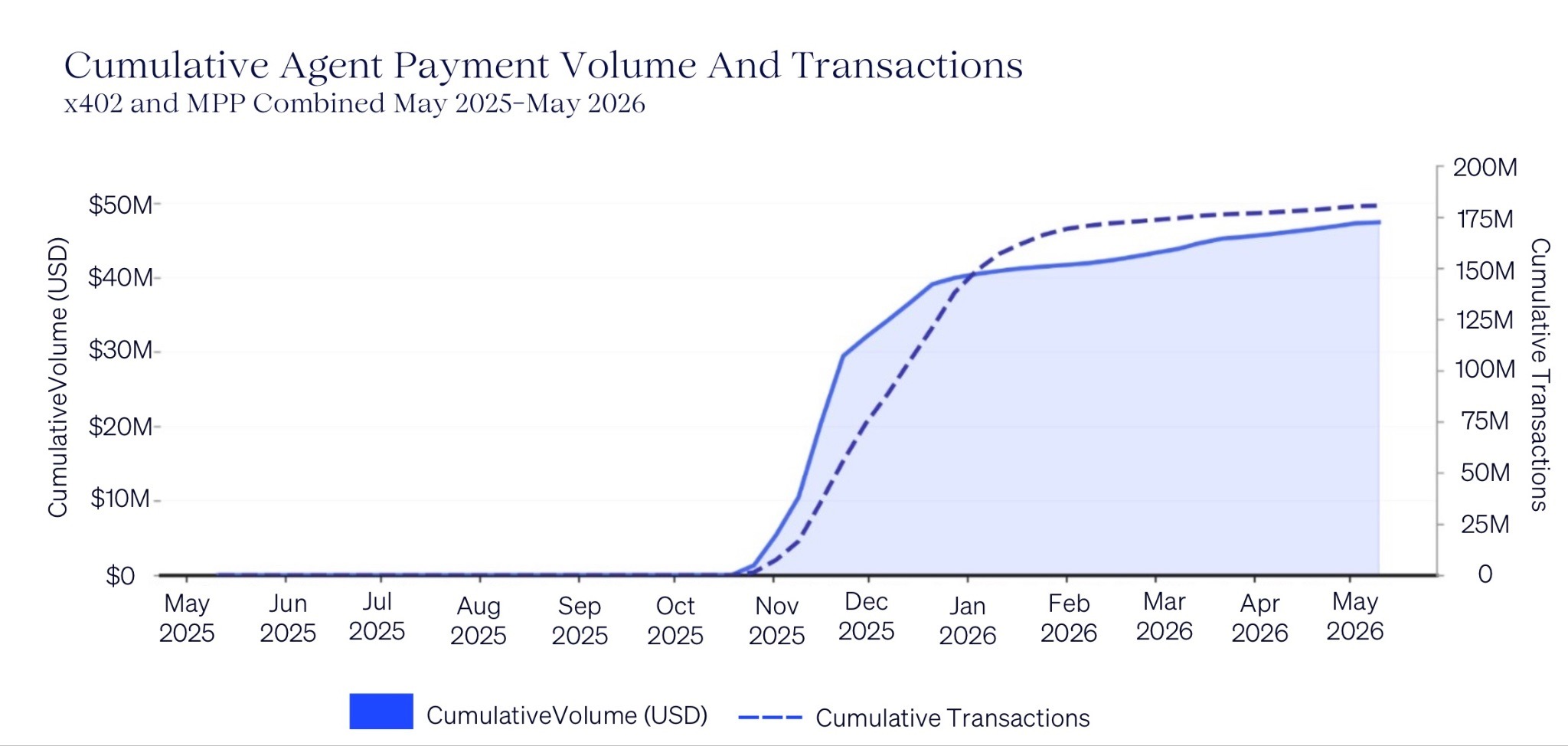
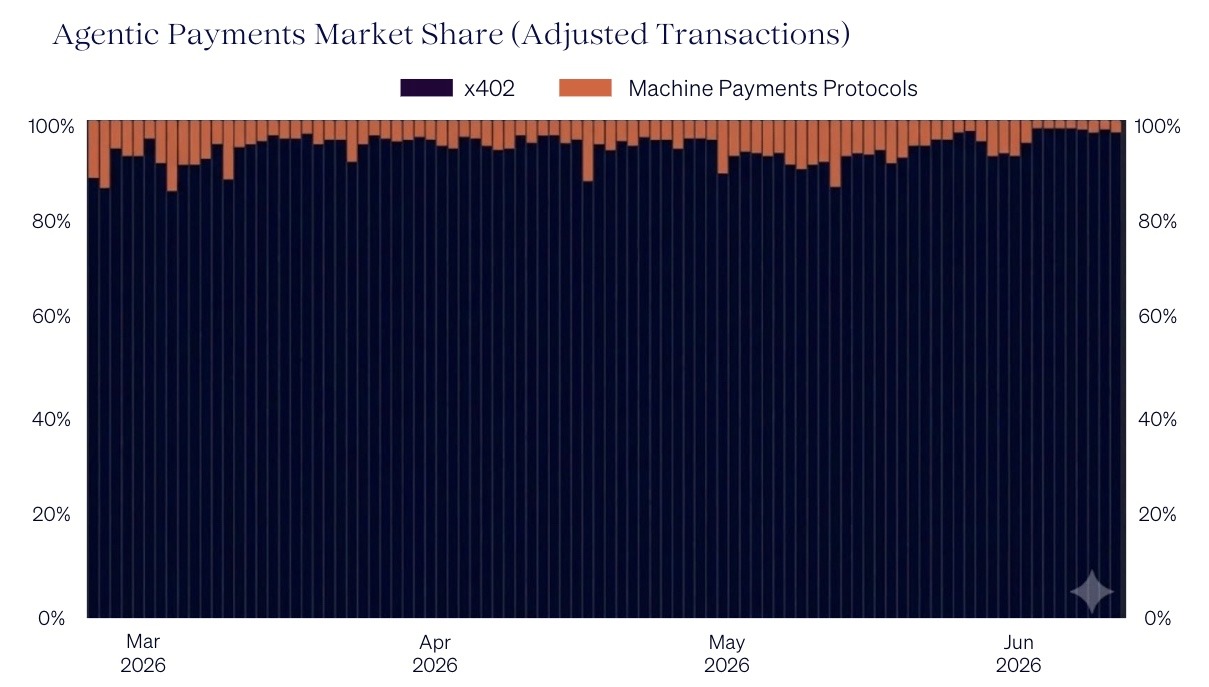
Agent payment volume was effectively zero through the first half of 2025. The inflection occurred in November 2025, when both the transaction and volume curves turned sharply upward. By May 2026, cumulative volume approached $45 million across roughly 175 million transactions. The steep initial ramp, followed by gradual deceleration, reflects the natural trajectory of early protocol adoption: aggressive deployment by builders, followed by consolidation as the most durable use cases establish themselves. Market share data reinforces this consolidation dynamic: x402 has consistently commanded above 90% of adjusted agentic transactions since March 2026, with Machine Payments Protocols accounting for the remainder. Protocol-level dominance at this stage suggests x402 has established itself as the default settlement layer for agent payments.
3.2 Settlement Currency: USDC Dominance
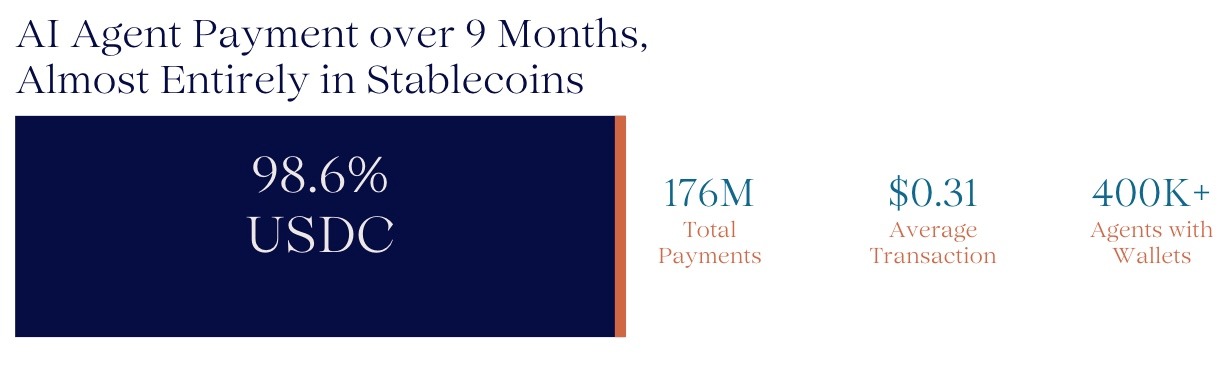
One of the most analytically significant findings is the near-total dominance of USDC as the settlement currency for agent payments. At 98.6% of all transactions, USDC is the de facto machine-native currency. This reflects the properties that make a stablecoin suitable for agentic use: regulatory clarity under MiCA and the US GENIUS Act, deep liquidity across chains, programmability, and institutional counterparty acceptance. The aggregate figures stand at 176 million total payments and a /bin/sh.31 average transaction size. At that level, blockchain settlement is unambiguously more efficient than card networks, which cannot economically process sub-dollar transactions.
3.3 Transaction Size Dynamics
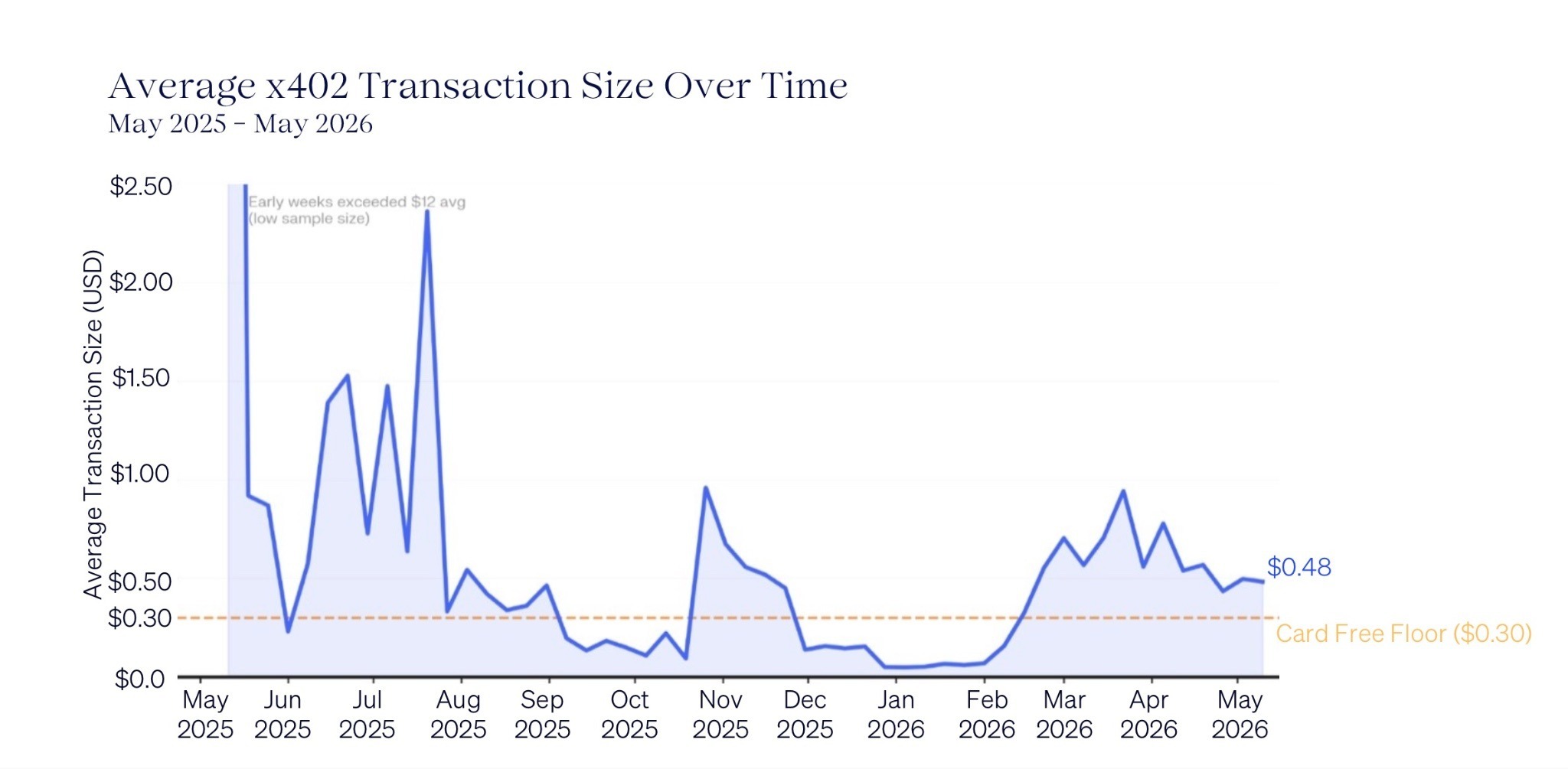
Early adoption in mid-2025 saw high average transaction sizes driven by low sample volumes and developer experiments. As adoption scaled through Q4 2025 and into 2026, average sizes compressed toward and below the $0.30 card fee floor. Today, 76% of agent transactions fall below that threshold, with most payments ranging between one and ten cents. At a current average of $0.48, agent payments fall within a range where blockchain settlement offers a structural cost advantage over traditional rails: stablecoin settlement on networks such as Base costs fractions of a cent, making card infrastructure economically impractical for agents purchasing data, AI inference, or API access. This is not incidental. It is the economic reason why stablecoin rails are winning as the default settlement layer for autonomous agents.
4. Key Players and Ecosystem Map
The agentic finance ecosystem is in its early stages and fragmented, but distinct categories of participants have emerged.
4.1 Payment Protocol Layer
Coinbase open-sourced x402 and extended it with AgentKit, a developer toolkit for building on-chain agents with built-in wallet management, token transfers, and spend permission controls. Stripe and Tempo co-developed MPP and secured integration commitments from Anthropic, OpenAI, Visa, Mastercard, and Shopify before the mainnet launch in March 2026, grounding the protocol in TradFi payment infrastructure from the outset.
4.2 Agent Framework Providers
Virtuals Protocol has emerged as a leading platform for deploying tokenized AI agents, with cross-chain support and a no-code creation interface. By Q1 2026, Virtuals represented a significant share of x402 facilitator market volume. Coinbase AgentKit, Fetch.ai (via the ASI Alliance), and Bittensor provide competing frameworks, each with a different architectural approach: AgentKit prioritizes developer experience within the Coinbase ecosystem; Fetch.ai emphasizes decentralized compute and multi-agent coordination; Bittensor focuses on decentralized machine learning infrastructure.
4.3 Traditional Finance Entrants
Institutional engagement is accelerating. JPMorgan Kinexys is piloting agent-driven settlement and liquidity management. Citi has integrated AI agents into cross-border payment workflows. Major custodians including BitGo and Fireblocks are building agent-compatible API layers with programmatic spending controls. The DTCC tokenization pilot beginning July 2026, backed by BlackRock, Goldman Sachs, and JPMorgan, will expand the on-chain asset universe available to financial agents to include Russell 1000 equities, major ETFs, and US Treasuries.
5. AI Agents in Action: Real-World Use Cases
The question most relevant to institutional participants is not which infrastructure protocols exist but what agents are actually doing in production today. The following use cases are live or in advanced pilot, representing the first generation of autonomous financial actors operating on stablecoin rails.
5.1 DeFi Yield Optimization
The most mature deployment category is automated yield management across DeFi lending markets. Agents built on frameworks such as Coinbase AgentKit, an open-source toolkit that allows AI models to execute on-chain transactions autonomously, and Autonolas, a protocol for deploying coordinated multi-agent services on decentralized infrastructure, continuously monitor rates across Aave, Compound, Morpho, and Spark Protocol, then reallocate stablecoin liquidity to the highest-yielding protocol within pre-set risk parameters. Unlike traditional algorithmic strategies, these agents validate against on-chain sources of truth before each action, detect anomalies in smart contract behavior, and pause or flag positions if oracle prices deviate beyond acceptable thresholds. Several crypto-native treasury desks are already using agents to manage operational USDC reserves, capturing 30 to 80 basis points of incremental yield versus static allocations.
5.2 RWA Portfolio Rebalancing
As tokenized Treasury products such as BlackRock BUIDL, Ondo USDY, and Franklin Templeton BENJI have grown in on-chain liquidity, agents are being deployed to dynamically rebalance between tokenized T-bills and DeFi yield sources based on duration targets and real-time yield spreads. Both approaches exist in practice: off-the-shelf solutions such as Vaultcraft and Yearn v3 offer pre-configured agent vaults that automate this rebalancing without custom development, while teams with more specific mandates build proprietary agents using frameworks such as Coinbase AgentKit or Autonolas, connecting to on-chain data feeds and executing transactions through smart contract interfaces. In either case, the agent monitors the yield differential between the tokenized money market product and the best available DeFi lending rate, executing reallocation when the spread exceeds a defined threshold. What previously required a treasury analyst to monitor and execute manually now runs continuously without human input, with a full on-chain audit trail for every reallocation event.
5.3 Cross-Border Payment Routing
Payment infrastructure providers use agents to find and execute optimal settlement paths across chains and corridors. Given a payment instruction (send 50,000 USDC from a European counterparty to a Gulf-based recipient), the agent evaluates available bridge routes, gas costs, settlement finality times, and compliance requirements in real time, then executes the lowest-cost compliant path without manual intervention. Early deployments by fintechs operating in the UAE and Southeast Asian corridors report reductions in settlement time from hours to under three minutes, at a fraction of correspondent banking fees.
5.4 Automated Compliance Monitoring
One of the highest-value but least publicized use cases is on-chain compliance surveillance. Agents monitor wallet activity against sanction lists, transaction graph anomalies, and Travel Rule thresholds in real time. When a transaction pattern triggers a rule, the agent can autonomously freeze a pending transfer, generate a draft Suspicious Activity Report, and alert a compliance officer, all before the transaction settles. Several MiCA-regulated CASPs are piloting this approach, using agents to reduce the manual review burden on compliance teams while improving detection latency from hours to seconds.
5.5 Data Monetization via x402
A growing category of agents acts as data vendors in a machine-to-machine marketplace. Research providers, oracle operators, and proprietary data producers expose their feeds through x402-enabled endpoints, allowing other agents (and human developers) to query and pay per request in USDC without subscription contracts or API key management. An agent running a yield optimization strategy might autonomously purchase real-time gas price data, a DEX liquidity depth snapshot, and a credit risk score from three different providers in a single workflow, paying sub-cent amounts for each. This is the use case that most directly explains the $0.31 average transaction size observed in the Keyrock data: micro-payments for data primitives consumed by other agents.
5.6 Institutional Treasury Management
At the institutional end, several crypto-native funds and DAOs are piloting multi-agent treasury systems in which a strategic allocation agent sets portfolio weights, a risk monitoring agent enforces drawdown limits, and an execution agent routes orders across venues. The agents communicate via A2A, share a deterministic policy engine that enforces compliance rules, and produce a complete audit trail of every decision and action. Human oversight is maintained at the policy level: the mandate and parameters are set by a human; the continuous execution is fully autonomous. This architecture directly addresses the operational risk of managing 24/7 digital asset portfolios using human trading desks that cannot continuously monitor markets.
6. The Regulatory Dimension: MiCA, VARA, and Uncharted Territory
6.1 Where MiCA Is Silent
MiCA establishes a comprehensive framework for crypto-asset service providers in the EU, defining obligations for both natural persons and legal entities. An AI agent that autonomously executes trades, manages a portfolio, or initiates transfers on behalf of a client fits cleanly into neither category. MiCA does not explicitly address autonomous agents as counterparties. The closest relevant provisions concern algorithmic trading and automated execution, but were drafted with deterministic, rule-based systems in mind, not with adaptive AI agents capable of acting outside pre-specified parameters. ESMA has acknowledged the gap in its ongoing technical standards work, but no binding guidance specific to AI agents has been issued as of June 2026.
The practical implication for MiCA-regulated firms is that deploying or servicing AI agents in a financial capacity likely requires mapping agent activities to existing service categories and obtaining the corresponding authorization. A firm whose agent autonomously buys and sells crypto-assets on behalf of clients is almost certainly providing portfolio management services under MiCA Article 3, regardless of whether a human approves each trade.
6.2 AML, KYC, and the Autonomous Counterparty Problem
AML and KYC frameworks globally are built on the assumption that financial counterparties are identifiable persons or entities. An AI agent with its own wallet is an identifiable on-chain actor, but the agent is not a person, and the beneficial owner of its transactions may be obscured across layers of delegation. Under the Travel Rule (FATF Recommendation 16, implemented in MiCA for transfers above EUR 1,000), when the originating party is an autonomous agent, mapping Travel Rule obligations to the human principal is non-trivial, particularly in multi-agent architectures in which one agent delegates to another.
6.3 Liability and Accountability
When an autonomous agent executes a transaction that results in a loss or triggers a compliance event, accountability attribution in multi-agent systems is genuinely difficult. Regulators across jurisdictions are converging on the view that the deploying firm retains full accountability for agent actions, but this principle poses a risk-management challenge with no clear precedent in traditional financial services.
Conclusion
Agentic Finance is moving from infrastructure buildout to early production deployment. The four primitives (APIs, MCP, A2A, and the x402 payment layer) are now sufficiently mature to support real economic activity, as confirmed by more than 35 million x402 transactions processed on Solana alone by March 2026 and over $40 million in cumulative protocol volume, a figure that understates total activity given parallel settlement across Base, Arbitrum, and Stellar.
The next phase of growth will be driven by three forces. First, the expansion of on-chain assets: as the DTCC pilot brings tokenized equities and Treasuries on-chain in H2 2026, agents will gain access to an asset universe that dwarfs current DeFi liquidity. Second, institutional deployment: custodians, payment providers, and asset managers are now building agent-compatible infrastructure, and the DTCC participant list confirms the seriousness of that commitment. Third, regulatory clarification: as MiCA technical standards and activity regulations explicitly address autonomous agents, the compliance path for institutional deployment will become clearer, removing the single largest barrier to scale.
The concentration of agent settlement in USDC at 98.6% reinforces a broader structural observation: the agent economy is a stablecoin economy. Regulated stablecoin issuers with MiCA authorization are, by extension, foundational infrastructure for the agent economy. Firms that understand both the technology stack and the regulatory perimeter are positioned to serve a client base that will need both.
The question is not whether agentic finance will become material. It is whether a regulated, compliant infrastructure will be ready when institutional demand arrives at scale.
Bitcoin retests support after January rally, absorbs geopolitical shocks, Fed holds rates, and 2026 opens with resilient digital asset fundamentals.